DTi is a professional chemical testing organization around you!

0755-32936716

Hotline:13923722641

News

Real-time dynamic update of company/industry news

Position:Home > News > Statute

Nordic compliance red alert: Swedish KEMI appliance spot check sounds alarm bell

Date:2026-05-20 10:21:26 Classification :【Statute】 Visits:

Electronics companies exporting to the EU and targeting the Nordic market need to pay close attention! The Swedish Chemicals Agency (KEMI) recently released its 2025 special inspection report on electrical and electronic products. Of the 209 samples covering categories such as headphones, lamps, and charging cables, 30% had excessive levels of hazardous substances. Coupled with the rampant abuse of CE marking, this serves as a red alert for Chinese electronics companies expanding into the Nordic and even the entire European market.
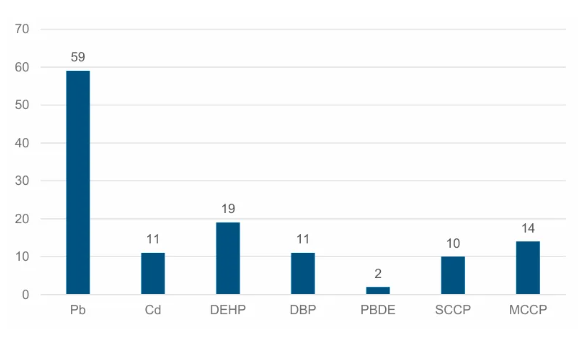


Caption: Number of Products Containing Excessive Levels of Restricted Substances

I. Two Major Areas of Violation

Over 30% of Products Exceed Hazardous Substance Standards

Spot checks revealed that over 30% of products violated the EU RoHS Directive or POPs regulations. Lead, cadmium, short-chain chlorinated paraffins (SCCPs), medium-chain chlorinated paraffins (MCCPs), phthalates DEHP, and DBP were all detected:

• Lead Contamination: 59 products exceeded lead content standards, with violations concentrated in circuit board solder joints, speakers, small motors, and plastic components in wires;

• High-Risk Plasticizers Persist: SCCPs, DEHP, and DBP were frequently detected in the soft plastic of cables. Long-term exposure to these substances can harm human health and damage the environment.

CE Marking Counterfeiting Rate Reaches 80%

Of all the products found to contain prohibited substances, 80% had incorrect CE markings. Counterfeit CE markings not only disrupt the Nordic market order but also undermine the credibility of CE certification, directly affecting the product's eligibility for market access throughout Europe. II. Signals of Increased Regulatory Oversight: Low-Priced Products Become a Key Target for Inspection

As the core enforcement agency for EU regulations in the Nordic region, Sweden's KEMI (Knowledge, Equipment, and Manufacturing) has stricter inspection standards than the EU baseline, and the results directly determine a product's market access in the Nordic region. Following this inspection, KEMI clearly stated that it will continue to focus on strictly inspecting low-priced electronic products, and its routine risk inspection mechanism will maintain a high-pressure stance in the long term.

For Chinese electronics exporters, it is necessary to re-examine supply chain compliance management, strengthen raw material testing and production process control, and standardize the use of CE marking to avoid market crises due to compliance loopholes.

III. Dezeway Compliance Solutions: Four Core Strategies for Coping with EU Spot Checks

Faced with increasingly stringent EU market access rules and frequent overseas spot checks, Shenzhen Dezeway, leveraging 16 years of testing and certification experience, has developed a systematic compliance solution for electronics export companies:

1. Full-Chain Supply Chain Management

Clearly communicating the limits for prohibited and restricted substances under multiple regulations such as RoHS/REACH/POPs to suppliers, embedding hazardous substance control requirements into the product design process, and establishing a full-process compliance management system from raw material procurement to finished product delivery, ensuring traceability of supplier compliance responsibilities.

2. Precise Screening of High-Risk Components

Focusing on high-frequency non-compliant components such as circuit board solder joints, speakers, small motors, and cable plastics, establishing a dedicated testing mechanism for high-risk substances such as lead, cadmium, short-chain chlorinated paraffins, and phthalates, blocking compliance risks at the component level.

3. Standardized Management of CE Marking

Strictly enforce CE marking usage regulations; products that have not passed compliance testing are strictly prohibited from affixing the CE marking. Ensure complete and clear product labeling information, including the manufacturer's name, address, and authorized representative information in the EU, to avoid market access issues due to marking problems.

4. Routine Testing and Early Warning Mechanism

Establish a routine testing system combining regular self-inspection and third-party testing to identify potential compliance risks in advance. Keep abreast of EU and Nordic market regulatory developments and adjust compliance strategies promptly to effectively mitigate the risks of penalties such as overseas inspection notices and product removal from shelves.

Copyright © Shenzhen DTi Technology Testing Co., Ltd. All Rights Reserved Record number: 粤ICP备18006753号-2  Shen Gongwang Security: 44030602006947
13923722641

报价二维码

报价二维码